
Grade 2 Science Lessons PDF Overview
Explore our Grade 2 Science PDF bundle, featuring 2.41 MB and 10.04 MB PDFs that cover core concepts. The 15.66 MB PowerPoint and 10.76 MB ready‑to‑use kit include workbook, teacher guide, and engaging slides—ideal for teachers, tutors, and homeschoolers. Download now for interactive learning. Join the fun!!.

PDF File Sizes and Formats
Our Grade 2 Science lesson PDFs are thoughtfully packaged to meet varied classroom demands and internet bandwidth limitations. The core PDF set is split into two distinct sizes: a compact 2.41 MB file that delivers concise lesson outlines, essential vocabulary lists, and streamlined activity prompts; and a richer 10.04 MB file that incorporates full lesson scripts, detailed teacher annotations, student worksheets, and high‑resolution visual aids. Both PDFs are fully searchable, feature embedded hyperlinks to external resources, and support annotations for collaborative learning. For educators who favor interactive presentations, a 15.66 MB PowerPoint (.pptx) file is also supplied, mirroring the PDF content while enabling slide animations, audio narration, and clickable quizzes. Additionally, a 10.76 MB ready‑to‑use kit bundles the PDF, PowerPoint, workbook, and teacher guide into a single compressed archive (.zip) for seamless distribution. All files are optimized for Windows and macOS, compatible with Adobe Acrobat Reader, Preview, Foxit Reader, and other common PDF viewers. To accommodate low‑bandwidth settings, a reduced‑resolution 1.8 MB PDF version is offered, whereas a high‑resolution 12.3 MB version contains full‑color images and print‑ready graphics. Each downloadable item is clearly labeled, and a checksum is provided to verify integrity. By presenting a spectrum of file sizes and formats, we empower teachers, tutors, homeschoolers, and students to access high‑quality science content regardless of technical constraints!!!

Ready-to-Use Lesson Kit Components
The ready‑to‑use kit delivers a 2.41 MB PDF workbook, a 10.04 MB PDF teacher guide, and a 15.66 MB PowerPoint deck. Each component is fully annotated, interactive, and ready for immediate classroom deployment. Ideal for teachers, tutors, and homeschoolers. All files are PDF‑compatible for use today!!!
Workbook
Our Grade 2 Science Workbook is a 2.41 MB PDF that blends foundational science concepts with hands‑on activities, quizzes, and reflection prompts. Designed for classroom, tutoring, and homeschooling, it offers a structured learning path that aligns with state standards while encouraging curiosity. Each chapter begins with a clear learning objective, followed by engaging illustrations, and real‑world examples that make abstract ideas tangible. Students will explore topics such as matter, energy, life cycles, and Earth systems through guided experiments, observation logs, and creative projects. The workbook includes a variety of assessment tools, including multiple‑choice questions, fill‑in‑the‑blank activities, and open‑ended prompts that allow teachers to gauge comprehension and provide targeted feedback. Teachers can easily track student progress with built‑in answer keys and suggested grading rubrics. The PDF format ensures compatibility across devices, allowing students to print, annotate, or use interactive features on tablets. With a user‑friendly layout, colorful visuals, and concise explanations, the workbook is crafted to support diverse learning styles and promote active engagement. Whether used as a primary resource or supplemental material, this workbook serves as a comprehensive, ready‑to‑use tool that enhances science instruction for Grade 2 learners.
Students can track progress with built‑in charts, and parents receive a summary report. The workbook’s modular design allows teachers to adapt lessons for mixed groups, ensuring every child engages with science concepts at pace. journal.!
Teachers Guide
Our Grade 2 Science Teachers Guide is a 10.04 MB PDF that provides educators with a comprehensive framework for delivering engaging science lessons. It includes lesson objectives, key vocabulary, and scaffolded instruction strategies that align with state standards. Each unit is broken down into daily lesson plans, complete with suggested timing, materials lists, and step‑by‑step teacher notes. The guide emphasizes inquiry‑based learning, encouraging students to ask questions, conduct simple experiments, and record observations. It also offers differentiated instruction ideas, allowing teachers to adapt activities for diverse learners, including visual, auditory, and kinesthetic styles. Assessment rubrics and formative checklists are embedded throughout, enabling quick evaluation of student understanding. Teachers can access downloadable PowerPoint slides, printable worksheets, and activity templates, all linked directly within the PDF. The guide’s layout is clean and user‑friendly, with color‑coded sections for easy navigation. Additionally, it includes reflective prompts for teachers to assess the effectiveness of each lesson and make adjustments. This resource is designed to save time while ensuring high‑quality, standards‑aligned science instruction for Grade 2 classrooms. The guide also offers professional development modules for teachers, including short videos, discussion prompts, and reflective journal templates. Weekly 30‑minute sessions help educators review concepts, troubleshoot challenges, and share best practices. A shared online folder lets teachers upload student work, lesson adaptations, and observations, fostering a collaborative community. A parent‑engagement section provides printable activity sheets, a glossary of key terms, and recommended science books and websites. The guide’s troubleshooting FAQ covers common classroom issues such as managing group work, ensuring safety during experiments, and differentiating instruction for English language learners. These resources empower teachers to deliver engaging, standards‑aligned science instruction that meets diverse student needs in every classroom setting for all learners.
PowerPoint Slides
Our 15.66 MB PowerPoint deck is engineered for Grade 2 science, featuring vibrant visuals, animated transitions, and interactive quizzes that keep young learners engaged. Each slide is paired with a concise teacher cue card, offering clear instructions and suggested discussion prompts. The deck covers core units—Matter, Physics, Biology, and Earth Science—delivering concepts through relatable examples, such as comparing the states of water or exploring the life cycle of a butterfly. Built‑in multimedia—short video clips, sound effects, and clickable hotspots—reinforces learning objectives while catering to diverse learning styles. The slide layout follows a consistent color scheme and large, legible fonts, ensuring accessibility for all students. Embedded formative assessment tools, including drag‑and‑drop matching activities and multiple‑choice polls, allow teachers to gauge comprehension in real time. The deck also includes a “Review & Reflection” section at the end of each unit, prompting students to summarize key ideas and ask questions. For classroom flexibility, the PowerPoint is fully editable; teachers can modify slide content, add their own images, or adjust pacing to fit lesson plans. A downloadable “Slide Master” template is provided, enabling seamless integration with existing curriculum materials. The presentation is optimized for both classroom projectors and individual devices, ensuring smooth performance on a variety of hardware. Additionally, the deck contains a “Teacher Resources” slide that links to downloadable worksheets, printable activity sheets, and a curated list of online science experiments suitable for Grade 2. This comprehensive, ready‑to‑use PowerPoint deck is designed to reduce preparation time, enhance student engagement, and support standards‑aligned instruction across all science domains for second‑grade classrooms. Teachers can export slides as PDFs for handouts and notes !
Matter Lesson Module
The Matter Lesson Module in our Grade 2 Science PDF set delivers a hands‑on exploration of solids, liquids, and gases. Students begin with a simple “What is Matter?” activity that uses everyday objects to classify states, followed by a guided inquiry lab where they observe ice melting, water boiling, and air filling a balloon. Each lesson includes a PowerPoint slide set, a printable worksheet, and a teacher’s guide with step‑by‑step instructions. The module emphasizes scientific vocabulary—solid, liquid, gas, density, and change—through interactive quizzes and matching games. A “Mystery Box” activity encourages students to predict the state of hidden items before revealing them, fostering hypothesis‑testing skills. The module also incorporates a “Build a Simple Machine” project, where students use magnets and magnets to illustrate how matter can be moved or transformed. Assessment is built into the module with exit‑ticket prompts and a short quiz that aligns with state standards. Teachers can download a “Lesson Summary” slide that recaps key concepts and a “Reflection Sheet” for students to write what they learned. The module is fully adaptable for blended learning, with optional video demonstrations and a digital lab notebook template. All resources are available in PDF format for easy printing and sharing. This comprehensive, engaging approach ensures that second‑grade students grasp the fundamentals of matter while developing critical thinking and scientific inquiry skills. Students will also create a simple poster summarizing the states of matter!!!!

Physics Lesson Module
Our Grade 2 Physics Lesson Module, part of the comprehensive PDF kit, introduces motion, force, and energy through engaging, age‑appropriate activities. Students start with a “Move It!” warm‑up, using a toy car and ramp to explore speed and distance. The module includes a hands‑on experiment where kids measure the force needed to push a weighted box across different surfaces, learning about friction. A guided inquiry segment asks students to predict which objects will fall faster and then test their hypotheses with a simple drop‑tower. The PowerPoint slides provide clear visuals of Newton’s three laws, simplified for young learners, while the workbook offers matching and fill‑in‑the‑blank exercises that reinforce key terms such as mass, weight, and momentum. The teacher’s guide supplies detailed lesson plans, timing suggestions, and assessment rubrics. A “Build a Simple Machine” activity lets students construct a lever using a ruler and a small weight, demonstrating how force can be amplified. The module also features a “Sound Exploration” station where students use a tuning fork and a rubber band to hear vibrations and understand sound waves. Assessment tools include a quick quiz, a reflection sheet, and a class poster project where students illustrate the concepts of motion and force. All materials are downloadable in PDF format for easy printing and sharing, ensuring that the lesson is ready to use in any classroom setting or homeschool environment. This module equips students with foundational physics knowledge and encourages curiosity through hands‑on learning!!! Students proudly share and celebrate!!!!!!

Biology Lesson Module
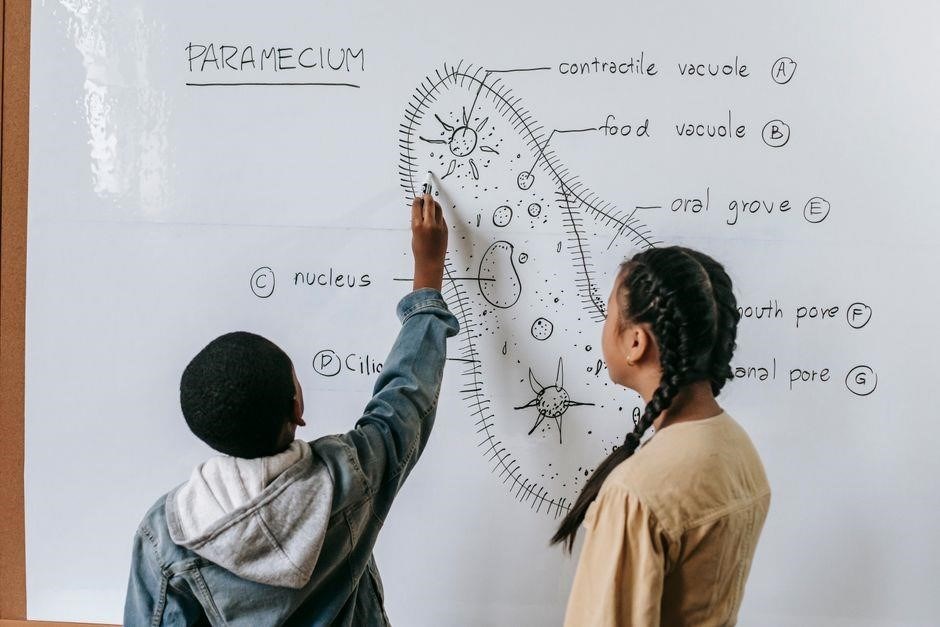
Our Grade 2 Biology Lesson Module, part of the downloadable PDF kit, guides young learners through the wonders of living things. The module opens with a “Life Cycle” storybook that introduces plants and animals, followed by a hands‑on seed‑planting activity where students plant beans in clear cups and observe root growth over a week. A “Food Web” diagram helps students understand how energy travels from the sun to producers, consumers, and decomposers. The PowerPoint slides feature bright illustrations of a butterfly life cycle, a simple animal classification chart, and interactive quizzes that ask students to match habitats to the animals that live there. The workbook contains matching exercises, a “Plant Parts” labeling activity, and a short writing prompt where students describe their own plant’s journey. The teacher’s guide offers step‑by‑step lesson plans, suggested timing, and formative assessment ideas such as exit tickets and a quick “What Did You Learn?” reflection. A “Micro‑World” station lets students magnify pond water under a microscope, spotting tiny organisms and learning about ecosystems. Assessment tools include a multiple‑choice quiz, a group poster project where students create a habitat collage, and a self‑assessment checklist. All resources are PDF‑ready for instant printing, ensuring a smooth, engaging lesson that sparks curiosity about biology and the natural world for every Grade 2 student. Celebrate learning!!!
Students also explore the five senses through a “Taste Test” activity, comparing sweet, salty, sour, bitter, and umami flavors using safe, child‑friendly foods. They record observations in a science journal, learning to describe and categorize. A “Healthy Habits” segment encourages daily routines such as handwashing and balanced meals, linking biology to personal well‑being. The module concludes with a “Nature Walk” checklist that guides students to identify plants, insects, and birds in their surroundings, fostering observation skills. Teachers can adapt the lesson for diverse classrooms, using the provided translation sheets and accessibility notes. The PDF format allows easy sharing with parents, ensuring continuity between school and home. This comprehensive module equips educators with everything needed to ignite a lifelong interest in biology for Grade 2 learners. Remember to keep the science notebooks tidy and colorful for best engagement!!!

Earth Science Lesson Module
Our Earth Science Lesson Module, part of the Grade 2 Science PDF kit, invites students to explore the planet’s dynamic systems. The module opens with a “Weather Watch” segment that explains clouds, wind, and temperature using a 15.66 MB PowerPoint slide deck. Students then conduct a simple barometer experiment, measuring air pressure changes over a week and recording data in the workbook. A “Water Cycle” activity uses a clear jar, water, and a plastic bag to demonstrate evaporation, condensation, and precipitation, reinforcing the concept with a matching worksheet. The “Rock Cycle” portion includes a hands‑on rock sorting game where learners classify igneous, sedimentary, and metamorphic samples, and a diagram that shows how heat and pressure transform rocks over time. A “Seasons” lesson uses a rotating globe model to illustrate Earth’s tilt and orbit, with an interactive quiz that asks students to predict seasonal changes in different hemispheres. The teacher’s guide offers detailed lesson plans, suggested timing, and formative assessment ideas such as exit tickets and a “Weather Diary” project. Assessment tools include a multiple‑choice quiz, a group poster on Earth layers, and a self‑assessment checklist. All resources are PDF‑ready for instant printing, ensuring a smooth, engaging lesson that sparks curiosity about Earth Science for every Grade 2 student. The PowerPoint includes animations that illustrate tectonic plate movement, and the workbook has a fill‑in chart for students to track their own weather observations. Teachers can adapt the module for diverse classrooms by using the provided translation sheets and accessibility notes. Students learn to identify weather symbols. Remember to keep the science notebooks tidy and colorful for best engagement!!!

Lesson Planning Tips
When preparing Grade 2 science lessons from the PDF kit, start by reviewing the 2.41 MB and 10.04 MB PDFs to identify key learning objectives. Align each objective with a specific slide in the 15.66 MB PowerPoint, ensuring the visual aids reinforce the text. Use the workbook’s guided questions to scaffold student inquiry, and schedule the hands‑on experiments—such as the barometer and rock‑sorting game—so that they fit within the 30‑minute lesson blocks. Incorporate the teacher’s guide’s suggested timing charts to balance instruction, practice, and assessment. For differentiated instruction, pull the ready‑to‑use lesson kit’s translation sheets and accessibility notes, and assign the “Weather Diary” project to students who thrive on creative expression. Include a quick formative check, like a 5‑question quiz, after each module to gauge comprehension. Record student responses in the assessment log, and use the data to adjust pacing for the next class. Finally, close each lesson with a reflection prompt that encourages students to articulate what they learned and how it connects to real‑world science. By following these steps, teachers can deliver engaging, standards‑aligned science experiences that maximize the value of the PDF resources!!!

Student Activities
Engage your Grade 2 learners with a series of hands‑on activities that complement the 2.41 MB and 10.04 MB PDFs, the 15.66 MB PowerPoint, and the 10.76 MB ready‑to‑use kit. Begin with the “Matter Mix‑Up” sorting game: students separate objects into solids, liquids, and gases, then record observations in the workbook’s activity sheet. Next, use the “Weather Detective” worksheet to track daily temperature, wind speed, and precipitation, linking data to the PowerPoint’s weather slide deck. For a science‑story project, have students create a short comic strip illustrating the water cycle, referencing the 10.04 MB PDF’s diagrams. Incorporate the “Plant Life Cycle” experiment by planting seeds in clear containers and documenting growth each week; students can annotate changes on the PDF’s growth chart. Include a “Sound Explorer” station where pupils use a tuning fork and a metal rod to discover vibration patterns, then sketch results in the workbook. End each lesson with a “Science Journal” entry, prompting students to explain one new concept they learned and how it applies to everyday life. These activities, drawn directly from the PDF kit, reinforce curriculum standards while fostering curiosity and critical thinking skills among young scientists. Students can also explore the “Light and Shadow” experiment by using flashlights to cast shadows on a whiteboard, then altering angles to observe changes. They will record results in the workbook’s light chart and discuss how light travels. These additional activities, sourced from the PDF kit’s supplemental worksheets, provide diverse learning experiences that cater to visual, auditory, and kinesthetic learners, ensuring every child finds a connection to science concepts and develops a lifelong love of discovery!!! :)!

Assessment Tools
Our Grade 2 Science PDF kit includes a suite of assessment tools designed to gauge student understanding and guide instructional adjustments. The workbook features built‑in checklists that align with each lesson’s learning objectives, allowing students to self‑check progress after completing activities. Teachers can use the accompanying rubric, which rates mastery on a 4‑point scale across key concepts such as matter states, weather patterns, and biological cycles. The PDF also offers a set of formative quiz sheets—multiple‑choice, true/false, and short‑answer—ready to print or embed in the PowerPoint slides for quick in‑class checks. For summative assessment, the kit provides a comprehensive test bank with answer keys, enabling teachers to assemble customized exams that reflect the breadth of the curriculum. Additionally, a digital portfolio template is included; students can upload photos of experiments, record observations, and reflect on learning, which teachers can review for formative feedback. The assessment tools are fully aligned with state science standards, ensuring that every question and rubric criterion supports measurable learning outcomes. By integrating these resources, educators can efficiently track student growth, identify misconceptions, and tailor instruction to meet diverse learner needs. The tools also support data‑driven decision making, making lesson planning more precise and effective for all students. Teachers can also employ the downloadable answer key sheets to conduct quick exit tickets, ensuring immediate feedback loops. The kit’s digital assessment dashboard allows for real‑time data visualization, helping educators spot trends across classrooms. For differentiated instruction, the rubric includes optional extension criteria, encouraging higher‑order thinking. Finally, the assessment package is compatible with common LMS platforms, streamlining submission and grading workflows. and collaborative learning.